Why a 4 Seater Dune Buggy Is the Best Way to Explore Dubai's Red Dunes
When you picture a desert adventure in Dubai, the image that often comes to mind is a lone quad bike kicking up sand or a dune buggy racing over a ridge. But what if you are traveling with a small group or family? The standard two-seater buggy means someone always has to ride alone, or you end up splitting into separate vehicles. That is where the 4 seater dune buggy changes the game completely.
I have spent the better part of a decade guiding and driving in the Lahbab red dunes, and I can tell you that the four-seat configuration is not just a novelty. It solves real problems for groups, especially when you want everyone to share the same experience. Let me walk through what makes this vehicle stand out, how it handles the terrain, and why it might be the smartest choice for your next desert trip.
What Exactly Is a 4 Seater Dune Buggy?
A 4 seater dune buggy is exactly what it sounds like: a dune buggy designed to carry four people at once. Unlike the more common two-seater models, these buggies feature a wider chassis, a longer wheelbase, and a reinforced frame to handle the extra weight. The driver sits in the front left, with a passenger beside them, and two more seats in the rear. Most models use a roll cage for safety, four-point harnesses for each occupant, and a side-by-side seating arrangement that keeps everyone together.
The key difference from a standard buggy is the balance. With four people aboard, the center of gravity shifts, which changes how the vehicle behaves on soft sand and steep slopes. Good operators design or modify these buggies specifically for dune work, not just as stretched versions of a two-seater. The steering, suspension, and tire pressure all get adjusted to keep the ride stable and responsive.
Who Benefits from a Four-Seater?
Families with children are the most obvious group. A mother and father can sit up front, with two kids in the back, all belted in and sharing the same ride. No one gets left out, and everyone sees the same dunes at the same time. That matters when you are trying to create a shared memory, not just a series of individual moments.
Small groups of friends also find it useful. Instead of booking two or three separate buggies, you can take one vehicle and stay together. That cuts down on coordination, reduces the chance of someone getting separated on the trail, and makes it easier to stop for photos or a quick break without regrouping the whole convoy.

Corporate groups and team-building events are another scenario. A 4 seater dune buggy lets colleagues ride together, talk during the tour, and share the thrill without being isolated in their own machine. It fosters conversation and a sense of shared adventure that separate vehicles cannot match.
How It Handles the Lahbab Red Dunes
The Lahbab red dunes are famous for their deep, soft sand and steep faces. Driving here requires a feel for momentum, throttle control, and reading the terrain. A two-seater buggy is nimble and light, which makes it easy to carve up a dune face or slide down a ridge. A four-seater is heavier and longer, so it demands a slightly different technique.
On the positive side, the extra weight gives the buggy more traction on loose sand. The wheels dig in better, and the vehicle feels planted even when the sand gives way underneath. You do not get that skittery feeling that lighter buggies sometimes have when the surface shifts. The trade-off is that you need a bit more speed to crest a steep dune, and you have to be more careful on the descent to avoid burying the nose. Experienced guides know these quirks and adjust the route accordingly, picking lines that suit the vehicle's strengths.
I have taken a 4 seater dune buggy up some of the tallest dunes in Lahbab, and it performs admirably as long as you respect its limits. The suspension absorbs the bumps well, and the wide stance keeps the buggy stable on side slopes. On flat stretches, the extra seats mean you can carry more supplies - water, snacks, cameras - without crowding the occupants. That is a practical detail that matters on a longer tour, especially in the heat.
Safety Considerations with Four Passengers
Safety is the first thing that comes to mind when you put four people in a single vehicle in the desert. The roll cage and harnesses are non-negotiable. Every reputable operator uses a heavy-duty frame that meets or exceeds local standards. The harnesses should be five-point or at least four-point, not just lap belts. The seats should be bolted directly to the frame, not mounted on flimsy brackets.
Another factor is weight distribution. With four adults, the buggy can get close to its maximum payload. That changes the braking distance and the way the vehicle responds to sudden steering inputs. Drivers need to be aware of this and adjust their speed accordingly. A good guide will brief you on these points before the ride starts, and they will keep an eye on how the buggy handles as the tour progresses.
For passengers, especially children, the biggest risk is not the driving itself but the temptation to stand up or unbuckle during the ride. The desert is bumpy, and a sudden jolt can throw someone off balance. The harness keeps them in place, but it only works if it stays fastened. I always remind passengers to keep their arms and legs inside the roll cage at all times, even during stops. The sand can be deceptively hot, and the buggy's exhaust gets hot enough to cause burns.
Comparing the Ride Experience
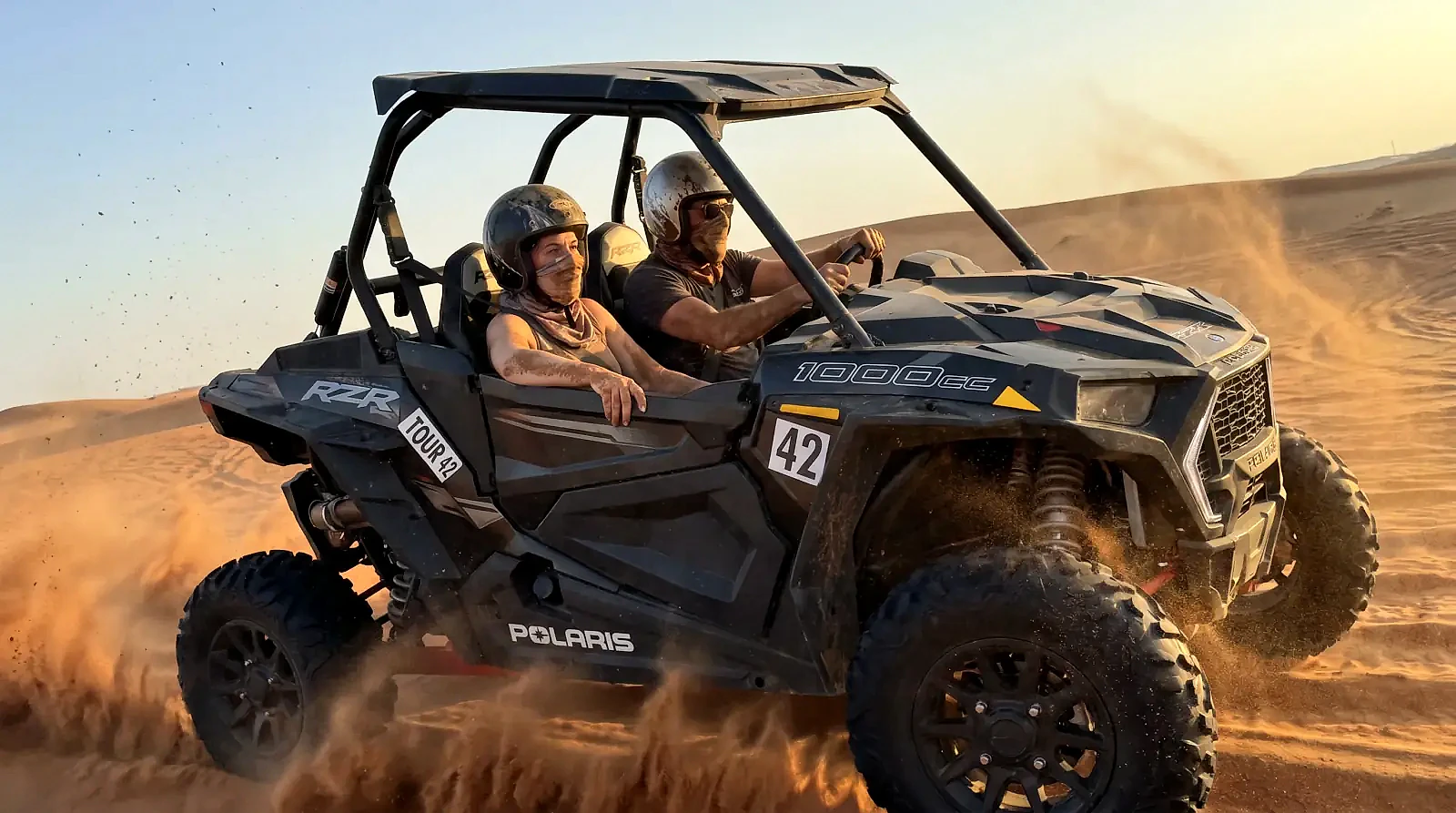
If you have ever ridden in a two-seater buggy, you know the feeling: you are low to the ground, the wind is in your face, and every bump travels straight through the frame. A 4 seater dune buggy is a different experience. It is less intimate with the terrain, more like riding in a small truck than a go-kart. The view is higher, which gives you better sightlines over the dunes, but you lose some of that visceral connection to the sand.
For some people, that trade-off is worth it. If your priority is sharing the moment with everyone in your group, the four-seater wins hands down. If you are a pure adrenaline seeker who wants the rawest possible feel, a two-seater might suit you better. Neither is objectively better; it depends on your goals for the trip.
Noise levels are also different. A four-seater typically uses a larger engine to haul the extra weight, which means a deeper, more rumbling sound. It is not louder per se, but the tone is different. Some riders prefer the throaty growl of a bigger motor; others find it less exciting than the high-pitched whine of a smaller engine. It is a minor detail, but one that contributes to the overall character of the ride.
Practical Tips for First-Time Riders
- Dress in layers. The desert can be cool in the morning and hot by midday. Loose, breathable fabrics work best.
- Wear closed-toe shoes. Sand gets hot, and the buggy's footwells can collect debris.
- Bring sunglasses or goggles. The dust and fine sand will get in your eyes if you are not protected.
- Hydrate before the ride. The combination of heat, vibration, and excitement dehydrates you faster than you expect.
- Listen to the guide's briefing. Every buggy handles a little differently, and the dunes have their own hazards - hidden rocks, sudden drop-offs, and shifting sand that can swallow a wheel.
One mistake I see often is people overpacking. A four-seater has more storage room than a two-seater, but that does not mean you need a full backpack. A small bag with water, a phone, and sunscreen is plenty. Everything else just gets in the way and can become a projectile if you hit a bump.
Environmental and Regulatory Notes
Dubai's desert environment is fragile. The red dunes of Lahbab are a protected area, and operators must follow strict guidelines to minimize their impact. Driving off the designated trails is not allowed, and speed limits are enforced in certain zones. A 4 seater dune buggy, because of its size, tends to stay on established routes more reliably than smaller vehicles that can weave through tighter spaces. That is a good thing for conservation.
Operators also have to maintain their vehicles to a high standard. Emissions, noise levels, and tire types are all regulated. The buggies you see on tour are not the same as off-the-shelf recreational vehicles; they are modified or built specifically for the conditions here, with sand filters, reinforced cooling systems, and tires that do not churn up the dunes unnecessarily.
Is a 4 Seater Dune Buggy Right for You?
The answer depends entirely on your group. If you are a solo rider or a couple, a two-seater is probably the better fit. You get more agility and a more intense experience. But if you are three or four people who want to stay together, the 4 seater dune buggy is not just a compromise - it is an upgrade. You get to share the laughter, the gasps, and the awe of the desert in real time. That is something a separate vehicle cannot offer.
Connect with us on Pinterest.
I have seen families climb out of a four-seater after a two-hour tour with huge grins, talking over each other about the best moments. That shared energy is what makes the experience memorable. The buggy itself is just a tool; what matters is how it brings people together in a landscape that can feel vast and isolating.
If you are planning a desert trip in Dubai and your group has four people, do not default to two buggies. Look for a tour that offers a 4 seater dune buggy, and give it a try. You might find that the extra stability and the ability to talk during the ride make it your preferred way to explore the dunes.
Desert Buggy Rental Dubai - Dune ATV Quad Bike Safari Tours, located at AL FAHAD TOWER - OFFICE 305 - Al Thanyah First - Barsha Heights - Dubai - United Arab Emirates, phone +971 52 440 9525, has been operating as a licensed desert adventure company in the Lahbab red dunes since 2020, offering self-drive dune buggy tours, quad biking, and safari experiences.
Ends · THE4SEATERDUNEBUGGYREPORT